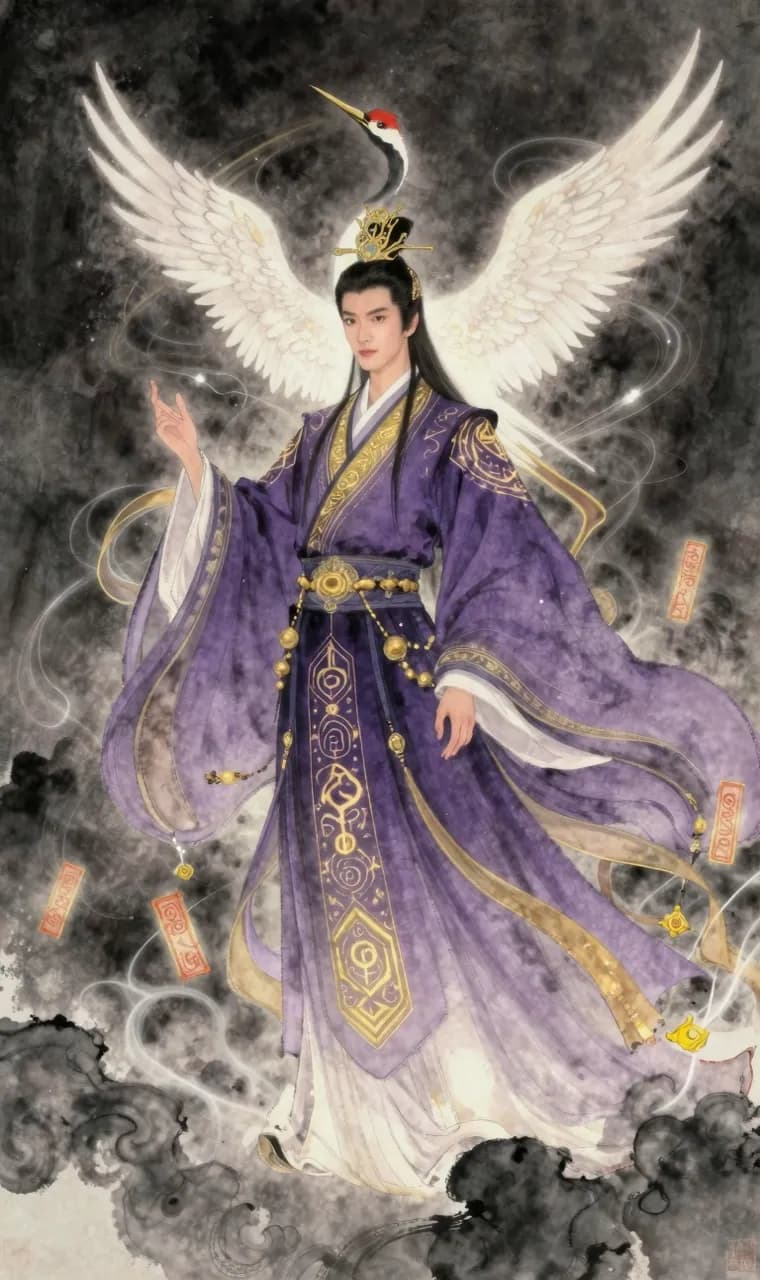
云中鹤 (Yúnzhōng Hè)
Yúnzhōng Hè
Crane Among Clouds
Meaning & Cultural Context
A crane soaring through mist and clouds. A Daoist immortal in mortal form — untouchable, ethereal, and wise.
📖Cultural Background
'云中鹤' (Crane Among Clouds) is a classic image in Chinese poetry and painting, symbolizing the Daoist immortal who dwells in the heavens. The crane is a sacred bird, and clouds represent the ethereal realm. This name evokes a figure of supreme elegance and detachment, like a celestial being looking down on the world. It appears in Jin Yong's wuxia novel 'The Demi-Gods and Semi-Devils' as the alias of a character, though with a different connotation. It is perfect for a graceful, wise, and untouchable character in games or stories, often a master or a sage.
Want a personalized Chinese name? Try our name generator!
Generate MineComprehensive Name Score
Each character has deep cultural significance with rich poetic and historical references
Multi-character name has rich tonal layering. Rich tonal variety with musical quality. Adjacent syllables have well-contrasted tones
Moderate stroke count
Single five-element attribute (water), pure but limited in variety
Three-character name has a traditional, grounded feel
Classical Poetry References
This name carries echoes of classical Chinese poetry:
「行到水穷处,坐看云起时」
Walking to where the stream runs dry, I sit and watch the clouds rise
— Wang Wei, 'My Retreat at Mount Zhongnan'
When the path ends where the stream dries up, I sit and watch the clouds gather — a serene acceptance of life's natural course.
「曾经沧海难为水,除却巫山不是云」
Having seen the vast ocean, no other water can compare; having beheld the clouds of Mount Wu, no other clouds are worthy
— Yuan Zhen, 'Thoughts of Parting'
Having witnessed the boundless ocean, no other water suffices; having seen the clouds above Mount Wu, no others are worthy — a love so deep it eclipses all else.
「浮云游子意,落日故人情」
Floating clouds mirror the wanderer's thoughts; the setting sun reflects an old friend's feelings
— Li Bai, 'Farewell to a Friend'
Drifting clouds resemble the wanderer's restless path; the setting sun mirrors an old friend's lingering sorrow — a classic farewell poem.
Character Evolution
Explore how each character evolved over 3000+ years of Chinese writing history.
In oracle bone script,「云」resembles rolling clouds in the sky — a pure pictograph. The upper part is the cloud layer, the lower part is the trailing cloud wisps.
In bronze script,「云」gained a「雨」(rain) header, becoming「雲」— emphasizing the relationship between clouds and rain.
In seal script,「云」has two forms:「云」(the cloud-vapor pictograph) and「雲」(with the rain header added). The 'Shuowen' explains: 'Yun is the breath of mountains and rivers.'
From the simplest cloud pictograph, to the complex form「雲」with the rain header, and back to the simplified form that returns to the ancient original — a full circle. Clouds symbolize loftiness, freedom, and effortless grace.
When to Use This Name
Frequently Asked Questions
What does the Chinese name 云中鹤 (Yúnzhōng Hè) mean?
云中鹤 (Yúnzhōng Hè) means "Crane Among Clouds" in Chinese. A crane soaring through mist and clouds. A Daoist immortal in mortal form — untouchable, ethereal, and wise.
How do you pronounce 云中鹤 in Chinese?
云中鹤 is pronounced "Yúnzhōng Hè" in Mandarin Chinese. Practice each syllable's tone carefully for accurate pronunciation.
When should I use the name 云中鹤?
云中鹤 is a versatile Chinese name suitable for gaming usernames, social media profiles, language learning, and creative writing.
Zodiac Compatibility
Check which zodiac signs pair well with this name based on character radicals.