The Answer: Wang (王) — Over 100 Million People Share It
The most common Chinese last name is Wang (王), which means "king." It is shared by more than 101 million people in mainland China alone — roughly 7.2% of the entire population. That means if you line up every 14th person in China, one of them will be named Wang. To put that in perspective, there are more people named Wang in China than the entire population of Germany. Wang also ranks as the most common surname in the world when counting a single country. The character 王 originally depicted a axe standing upright, symbolizing royal authority. Today, people named Wang trace their ancestry to multiple royal lineages across Chinese history, most notably the Zhou Dynasty (1046–256 BCE). When branches of the royal family lost their thrones, descendants adopted "Wang" (king) as their surname to preserve their noble heritage.
How to Pronounce Wang and Other Common Surnames
Chinese surnames use tones that change the meaning entirely if mispronounced. Here is a quick guide to the top five: Wáng (王) — rising tone (like asking "what?"), sounds roughly like "wahng." Lǐ (李) — falling then rising tone, sounds like "lee" but dip your voice down then back up. Zhāng (张) — high flat tone, sounds like "jahng" with your voice staying level and high. Liú (刘) — rising tone, sounds like "lyoh" rising at the end. Chén (陈) — rising tone, sounds like "chun" with voice going up. A common mistake English speakers make is saying "Wang" with a flat or falling tone. In Mandarin, that could make it sound like a completely different word. The rising tone (second tone) is essential. When in doubt, listen to a native speaker on Forvo or Google Translate and mimic the pitch pattern.
Top 100 Chinese Surnames Ranked by Population
| Rank | Surname | Character | Pinyin | Meaning | Est. Population |
|---|
| 1 | Wang | 王 | Wáng | King | 101.5M |
| 2 | Li | 李 | Lǐ | Plum | 100.9M |
| 3 | Zhang | 张 | Zhāng | Bow / Stretch | 95.4M |
| 4 | Liu | 刘 | Liú | Destroy / Axe | 72.1M |
| 5 | Chen | 陈 | Chén | Display / Ancient state | 63.3M |
| 6 | Yang | 杨 | Yáng | Poplar tree | 46.2M |
| 7 | Huang | 黄 | Huáng | Yellow | 33.7M |
| 8 | Zhao | 赵 | Zhào | Exceed / Ancient state | 28.6M |
| 9 | Wu | 吴 | Wú | Name of ancient state | 27.8M |
| 10 | Zhou | 周 | Zhōu | Circumference / Zhou Dynasty | 26.8M |
| 11 | Xu | 徐 | Xú | Gentle / Slow | 20.2M |
| 12 | Sun | 孙 | Sūn | Grandchild | 19.4M |
| 13 | Ma | 马 | Mǎ | Horse | 17.2M |
| 14 | Zhu | 朱 | Zhū | Vermillion red | 15.1M |
| 15 | Hu | 胡 | Hú | Beard / Wild | 14.1M |
| 16 | Guo | 郭 | Guō | Outer city wall | 13.6M |
| 17 | He | 何 | Hé | What / Carry | 13.0M |
| 18 | Gao | 高 | Gāo | High / Tall | 12.8M |
| 19 | Lin | 林 | Lín | Forest | 12.4M |
| 20 | Luo | 罗 | Luó | Net / Collect | 11.6M |
| 21–30 | 31. Liang (梁 Liáng, bridge) 32. Song (宋 Sòng, Song Dynasty) 33. Zheng (郑 Zhèng) 34. Xie (谢 Xiè, thank) 35. Han (韩 Hán) 36. Tang (唐 Táng) 37. Feng (冯 Féng) 38. Yu (于 Yú) 39. Dong (董 Dǒng) 40. Xiao (萧 Xiāo) |
| 31–40 | 41. Cheng (程 Chéng) 42. Cao (曹 Cáo) 43. Yuan (袁 Yuán) 44. Deng (邓 Dèng) 45. Xu (许 Xǔ) 46. Fu (傅 Fù) 47. Shen (沈 Shěn) 48. Zeng (曾 Zēng) 49. Peng (彭 Péng) 50. Lu (吕 Lǚ) |
| 41–50 | 51. Su (苏 Sū) 52. Lu (卢 Lú) 53. Jiang (蒋 Jiǎng) 54. Cai (蔡 Cài) 55. Jia (贾 Jiǎ) 56. Ding (丁 Dīng) 57. Wei (魏 Wèi) 58. Xue (薛 Xuē) 59. Ye (叶 Yè) 60. Yan (阎 Yán) |
| 51–60 | 61. Yu (余 Yú) 62. Pan (潘 Pān) 63. Du (杜 Dù) 64. Dai (戴 Dài) 65. Xia (夏 Xià) 66. Zhong (钟 Zhōng) 67. Wang (汪 Wāng) 68. Tian (田 Tián) 69. Ren (任 Rèn) 70. Jiang (姜 Jiāng) |
| 61–70 | 71. Fan (范 Fàn) 72. Fang (方 Fāng) 73. Shi (石 Shí) 74. Yao (姚 Yáo) 75. Tan (谭 Tán) 76. Liao (廖 Liào) 77. Zou (邹 Zōu) 78. Xiong (熊 Xióng) 79. Jin (金 Jīn, gold) 80. Lu (陆 Lù) |
| 71–80 | 81. Hao (郝 Hǎo) 82. Kong (孔 Kǒng, Confucius' surname) 83. Bai (白 Bái, white) 84. Cui (崔 Cuī) 85. Kang (康 Kāng) 86. Mao (毛 Máo) 87. Qiu (邱 Qiū) 88. Qin (秦 Qín) 89. Jiang (江 Jiāng, river) 90. Shi (史 Shǐ, history) |
| 81–90 | 91. Gu (顾 Gù) 92. Hou (侯 Hóu, marquis) 93. Shao (邵 Shào) 94. Meng (孟 Mèng) 95. Long (龙 Lóng, dragon) 96. Wan (万 Wàn, ten thousand) 97. Duan (段 Duàn) 98. Lei (雷 Léi, thunder) 99. Qian (钱 Qián, money) 100. Wu (武 Wǔ, martial) |
Source: China Ministry of Public Security surname report. Population figures are approximate for mainland China.
These 100 surnames together cover approximately 85% of China's 1.4 billion people. The concentration is staggering: just the top 3 (Wang, Li, Zhang) account for nearly 300 million people. This is why you will meet so many Chinese people who share the same last name — it is not coincidence but history.
The Stories Behind China's Biggest Surnames
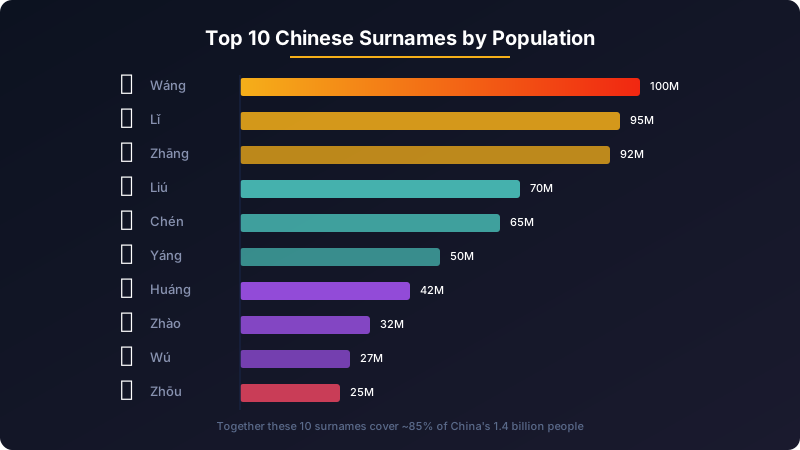
Every major Chinese surname carries centuries of history. Wáng (王) emerged when Zhou Dynasty princes lost their kingdoms and took "king" as a surname to honor their royal blood. The most famous Wang in history is Wang Xizhi, the greatest calligrapher who ever lived, whose Lanting Ji Xu (Preface to the Poems Collected from the Orchid Pavilion) is considered the pinnacle of Chinese brush writing. Lǐ (李) means "plum tree" and traces to the Tang Dynasty imperial family. Emperor Li Shimin (Taizong) made Li the most powerful surname in the 7th century. Legend says the surname originated when a Li ancestor, fleeing starvation, survived by eating plums and adopted the tree as his family name. Zhāng (张) means "bow" and was granted to Huangdi's grandson, who according to mythology invented the bow and arrow. Liú (刘) is the surname of the Han Dynasty founder Liu Bang, a peasant who became emperor and established one of China's greatest dynasties (206 BCE–220 CE). Chén (陈) comes from an ancient state in modern-day Henan. When the state fell, its people took its name as their surname, creating one of southern China's dominant family names. Zhào (赵) leads the Bǎi Jiā Xìng (Hundred Family Surnames) because the Song Dynasty emperor who commissioned the text was named Zhao — he put his own surname first.
Why China Has So Few Surnames Compared to the West
The United States has over 6 million recorded surnames. China, with four times the population, has only about 6,000. Three historical reasons explain this gap. First, imperial granting. Chinese emperors awarded surnames to large groups as rewards or acts of governance. When an emperor gave his surname to an entire village, thousands of unrelated people suddenly shared the same name. Second, adoption of ruler names. Commoners frequently adopted the surname of their local lord as a mark of loyalty or protection. Third, the Bǎi Jiā Xìng effect. The Song Dynasty text "Hundred Family Surnames" served as a cultural standard for over 1,000 years. Schoolchildren memorized it, reinforcing the dominance of a small set of surnames generation after generation. Unlike Europe, where surnames were often based on unique occupations (Smith, Baker, Taylor) or specific locations, Chinese surnames were consolidated early and remained stable.
Compound Surnames: China's Rare Two-Character Names
While 99% of Chinese surnames are a single character, a small number of families carry compound surnames (fù xìng 复姓) made of two characters. These are aristocratic relics from ancient China. Sīmǎ (司马) means "controller of horses" and was a military title in the Zhou Dynasty that became a surname. The most famous Sima is Sima Qian, the father of Chinese historiography. Ōuyáng (欧阳) traces to a noble family in the Spring and Autumn period. Zhūgě (诸葛) is the surname of Zhuge Liang, the legendary strategist from the Romance of the Three Kingdoms. Sītú (司徒) means "minister of education" and originated from an official government title. These compound surnames are increasingly rare. Some, like Dōngfāng (东方, "east"), have fewer than 100 bearers nationwide, making them living cultural artifacts.
A Family Reunion That Put 'Wang' in Perspective
In the fall of 2019, a Wang family reunion took place in Hongtong County, Shanxi Province — a place considered the ancestral migration hub for northern Chinese surnames. Over 200 people showed up. Every single one of them was surnamed 王. But here is what made it extraordinary: these were not all from the same branch. They represented at least six distinct Wang lineages, each traceable to a different historical origin. One branch descended from Zhou Dynasty royalty. Another traced back to a Mongol chieftain who was granted the surname during the Yuan Dynasty. A third group had originally been named 汪 (Wāng, a different character) but simplified to 王 during a bureaucratic reshuffling in the 1950s.
The family genealogy book — a hand-bound volume with cloth covers, passed down through the eldest son of each generation — documented 23 generations of the host branch alone. Pages were written in classical Chinese with red ink annotations added by successive family historians. Some entries recorded imperial examination results from the Ming Dynasty. Others noted which family members had migrated to Taiwan in 1949. The book was fragile enough that the current keeper wore white cotton gloves to turn the pages.
What struck me most was a quiet moment near the end of the day. An elderly man in his eighties, Wang Fugui, sat on a stone bench outside the ancestral hall. He told me his grandfather had attended a similar gathering in 1936, just before the war with Japan scattered the family across the country. "Back then, 400 came," he said. "My grandfather walked three days to get here. We drove four hours from Taiyuan. Different times, same name." He paused and looked at the courtyard full of strangers who shared his surname. "Being Wang means something. It means you are never truly alone in this country."
Find Your Own Chinese Name with AI
If you have read this far, you might be wondering what Chinese name would suit you. Whether you are a foreigner looking for an authentic Chinese name, a writer creating Chinese characters, or someone reconnecting with Chinese heritage, the right name matters. Our AI-powered Chinese name generator creates names that are culturally appropriate, tonally balanced, and rich in meaning. It handles the details that matter: proper character selection, pinyin pronunciation, tonal harmony between surname and given name, and cultural taboos to avoid. Each suggestion comes with a full breakdown of character meanings, so you understand exactly what your name says about you. Try it free — scroll to the top of this page and click "Generate My Chinese Name" to get started.
Ready to Find Your Chinese Name?
Try our expert Chinese name generator — free, with pinyin, meanings, and cultural context.
Generate My Chinese Name