What Makes a Chinese Last Name Rare?
While the top 100 Chinese last names cover 85% of the population, thousands of other surnames exist in tiny numbers. A Chinese last name is considered rare when fewer than 100,000 people share it — and some are held by just a handful of families. These rare Chinese last names often carry the most fascinating stories: ancient royal lines, lost kingdoms, and poetic origins that date back millennia.
Compound Surnames: Two-Character Last Names
The most visible category of rare Chinese last names is the compound surname (复姓, fùxìng). These are two-character family names that have been used for over 2,000 years. Some of the most well-known compound Chinese last names include 欧阳 (Ouyang), 司马 (Sima), 诸葛 (Zhuge), 上官 (Shangguan), and 皇甫 (Huangfu). Compound surnames account for less than 1% of all Chinese last names in use today. Many originated from ancient official titles: 司马 meant "Minister of War," 司徒 meant "Minister of Education," and 司空 meant "Minister of Works." Others came from place names or were bestowed by emperors.
Nearly Extinct Chinese Last Names
Some Chinese last names are on the verge of disappearing entirely. Names like 难 (Nan), 死 (Si), and 贶 (Kuang) have so few bearers that entire surname lineages may vanish within a generation. The character 难 (Nan), meaning "difficulty," is held by fewer than 100 people. The character 死 (Si), meaning "death," has become so undesirable that many families with this surname have petitioned to change it. Other nearly extinct surnames include 山 (Shan) when used as a surname (distinct from the common word for "mountain"), 哲 (Zhe), and 莽 (Mang). China's Ministry of Public Security has documented surnames with as few as a single registered bearer.
Rare Last Names from Ancient Kingdoms
Many rare Chinese last names are the last surviving traces of ancient states and kingdoms. When a kingdom was conquered, its people often adopted the kingdom's name as their surname to preserve their heritage. Examples include 桀 (Jie) from the Xia Dynasty's last ruler, 纣 (Zhou) from the Shang Dynasty's last ruler, and 褒 (Bao) from the ancient State of Bao. These surnames serve as living fossils of Chinese political history. Families bearing these names can often trace their ancestry to specific historical events recorded in classical texts like the Records of the Grand Historian (史记).
Ethnic Minority Last Names
China's 55 ethnic minority groups contribute many rare last names that most Han Chinese people have never encountered. Uyghur names like Abdulla and Mahmut, Tibetan names like Cairang and Dawa, and Miao names like Ghab represent entirely different naming traditions. Some minority surnames have been adapted into Chinese characters for official registration, creating unique hybrids. For example, the Manchu surname 爱新觉罗 (Aisin Gioro) — the imperial family of the Qing Dynasty — remains one of the most recognizable rare last names in China.
The Surname That Is Literally 'Number Five'
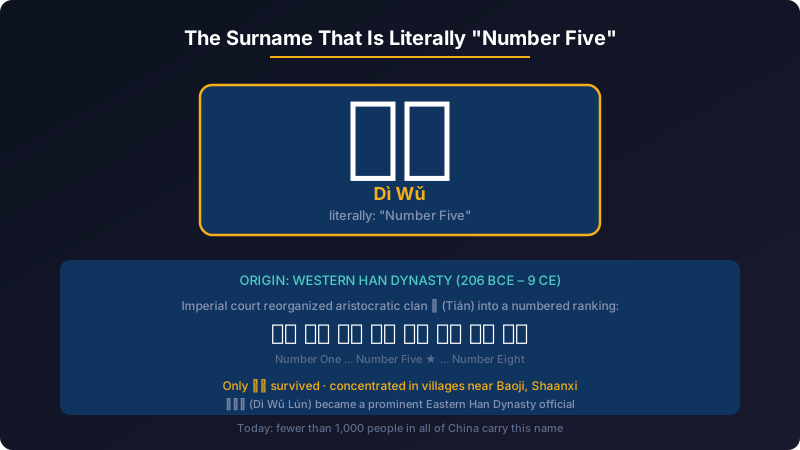
Of all the rare Chinese surnames I have come across, none stops people in their tracks quite like 第五 (Dì Wǔ). It translates literally to "Number Five." Not as a nickname or a joke — as a bona fide family name, registered with the Ministry of Public Security, printed on ID cards and household registries. There are fewer than a thousand people in all of China who carry this name. I first heard about it from a linguistics professor at Shaanxi Normal University who had spent years documenting endangered surnames in the Guanzhong region.
The origin is stranger than fiction. During the Western Han Dynasty (206 BCE – 9 CE), the imperial court reorganized aristocratic clans into a numbered ranking system. Branches of a powerful clan surnamed 田 (Tián) were assigned ordinal numbers as administrative designations: 第一 (Number One), 第二 (Number Two), and so on up through 第八 (Number Eight). Over generations, these designations hardened into actual surnames. Most died out. But 第五 survived, concentrated in a handful of villages near Baoji, Shaanxi. A man named 第五伦 (Dì Wǔ Lún) even became a prominent official during the Eastern Han Dynasty — his biography appears in the Book of Later Han (Hòu Hàn Shū).
What makes the surname especially tricky is how it functions in daily life. When someone named 第五 introduces themselves, the reaction is almost always the same: confusion, then disbelief, then a request to see their ID card. Bank tellers have refused to process transactions. Hotel check-in systems have rejected the two-character surname as an input error. One man surnamed 第五 told a local newspaper that he once spent 45 minutes at a government office convincing a clerk that his name was real. The clerk kept saying, "Sir, I need your actual surname, not your address or your queue number." He eventually had to bring his father's household registry to prove it.
Why Rare Chinese Last Names Matter
Rare Chinese last names are culturally significant because they preserve history, migration patterns, and family stories that would otherwise be lost. Genealogists and historians use rare surnames to trace population movements across thousands of years. In recent years, there has been a revival of interest in rare Chinese last names, with some families actively working to preserve their unique surname heritage through family registries (家谱) and cultural associations.
Ready to Find Your Chinese Name?
Try our expert Chinese name generator — free, with pinyin, meanings, and cultural context.
Generate My Chinese Name