How Chinese Last Names Came to America
Chinese last names first appeared in American records during the mid-1800s Gold Rush era, when Chinese immigrants arrived primarily from Guangdong and Fujian provinces. These early immigrants' surnames were recorded using Cantonese or Hokkien pronunciation — which is why Chinese American last names often look different from modern Mandarin pinyin. For example, the surname 陈 (Chen in Mandarin) became "Chan" in Cantonese-speaking communities, and 黄 (Huang) became "Wong."
Why Chinese American Last Names Look Different
If you compare Chinese American last names with mainland Chinese romanization, you will notice significant differences. This is because of different romanization systems: Cantonese romanization (used by early immigrants from Guangdong): 陈→Chan, 黄→Wong, 李→Lee, 张→Cheung. Wade-Giles (used in Taiwan and older academic texts): 张→Chang, 周→Chou, 郭→Kuo. Pinyin (modern mainland standard): 张→Zhang, 周→Zhou, 郭→Guo. A Chinese American family with the surname "Lee" (李), "Chan" (陈), or "Wong" (黄) likely has roots in southern China, while a family with "Li," "Chen," or "Huang" may have more recent immigration origins.
Most Common Chinese American Last Names
The most common Chinese American last names reflect both immigration patterns and romanization history. Based on US Census data, the top Chinese American surnames include: Wang/Wong (王), Lee/Li (李), Zhang/Chang/Cheung (张), Liu/Lau (刘), Chen/Chan (陈), Yang/Yeung (杨), Huang/Wong (黄), Wu/Ng (吴), Zhao/Chiu (赵), Lam/Lin (林). Note that some surnames like Wong (黄/王) and Lee (李) are shared across different Chinese characters, making exact counts complex.
The Lee/Li Surname in Chinese America
Lee is one of the most recognizable Chinese American last names, but its story is more nuanced than it appears. "Lee" is the Cantonese romanization of 李 (Lǐ), the second most common Chinese surname with over 100 million bearers worldwide. However, "Lee" can also represent the Cantonese pronunciation of 雷 (Léi) or 利 (Lì) — different Chinese characters entirely. Many Chinese Americans named Lee share the same Chinese character 李 with people named "Li" in mainland China. The difference is purely a matter of romanization style.
Three Branches, One Character, Three Different Names
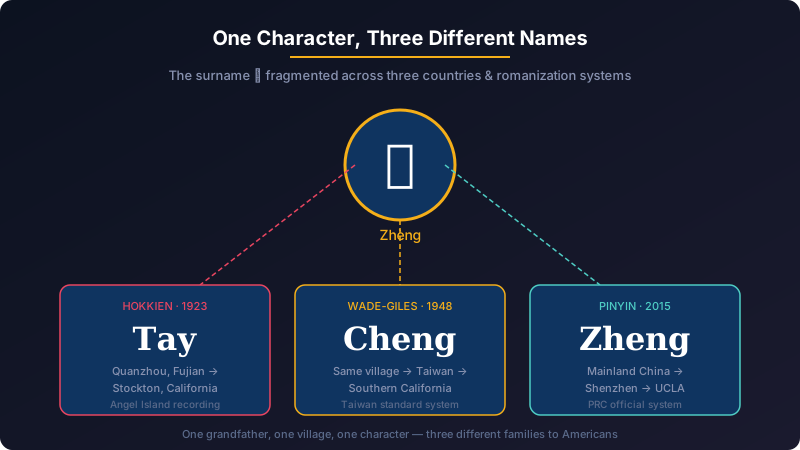
The surname 郑 (Zhèng) illustrates better than any other how a single Chinese character can fragment into completely different romanizations depending on immigration history. I learned this from a family I met in San Francisco's Richmond District in 2018. The patriarch, then 92 years old, had spent decades assembling a family tree spanning four countries. What he showed me was a single surname that had become three distinct English names.
The first branch — his own — had immigrated from a village near Quanzhou, Fujian Province, in 1923. They spoke Hokkien. In Hokkien, 郑 is pronounced roughly like "Tê." At Angel Island, the immigration officer wrote down what he heard: "Tay." The Tay family settled in Stockton, California. For three generations, nobody questioned it. His children and grandchildren went to school as Tay. His great-granddaughter's driver's license says Tay.
The second branch had left the same village in 1948, during the upheaval surrounding the Communist victory. They went to Taiwan. In Taiwan, the standard romanization system at the time was Wade-Giles, which rendered 郑 as "Cheng." This branch built a textile business in Taipei and eventually opened a factory in Southern California in the 1980s. When the cousins in Stockton (Tay) met the cousins from Taipei (Cheng) at a wedding in Monterey Park, the non-Chinese spouses were thoroughly confused. "Wait, you are all related but your last names are different?" One of the Taiwanese cousins tried to explain: "Same character. Different passport."
The third branch stayed in mainland China and later moved to Shenzhen for work. Their hukou (household registration), ID cards, and eventually passports used the pinyin system adopted by the PRC: "Zheng." When a younger member of this branch got a student visa to attend UCLA in 2015, her surname on official US documents became Zheng. At a family dinner that year — the first time all three branches had been in the same room — the patriarch looked around at his descendants and said something that stuck with me: "One grandfather, one village, one character. And now the Americans think we are three different families."
Chinese Last Names and American Identity
Chinese American last names carry layers of cultural identity. For many Chinese Americans, the surname is a connection to ancestral roots, immigration history, and family heritage. Some families have maintained their original romanization for generations, while others have adopted pinyin-style spelling. In professional settings, Chinese Americans often navigate between their Chinese name and an English given name, creating a hybrid identity reflected in names like "Jennifer Lee" (李Jennifer) or "David Wong" (黄David).
Ready to Find Your Chinese Name?
Try our expert Chinese name generator — free, with pinyin, meanings, and cultural context.
Generate My Chinese Name