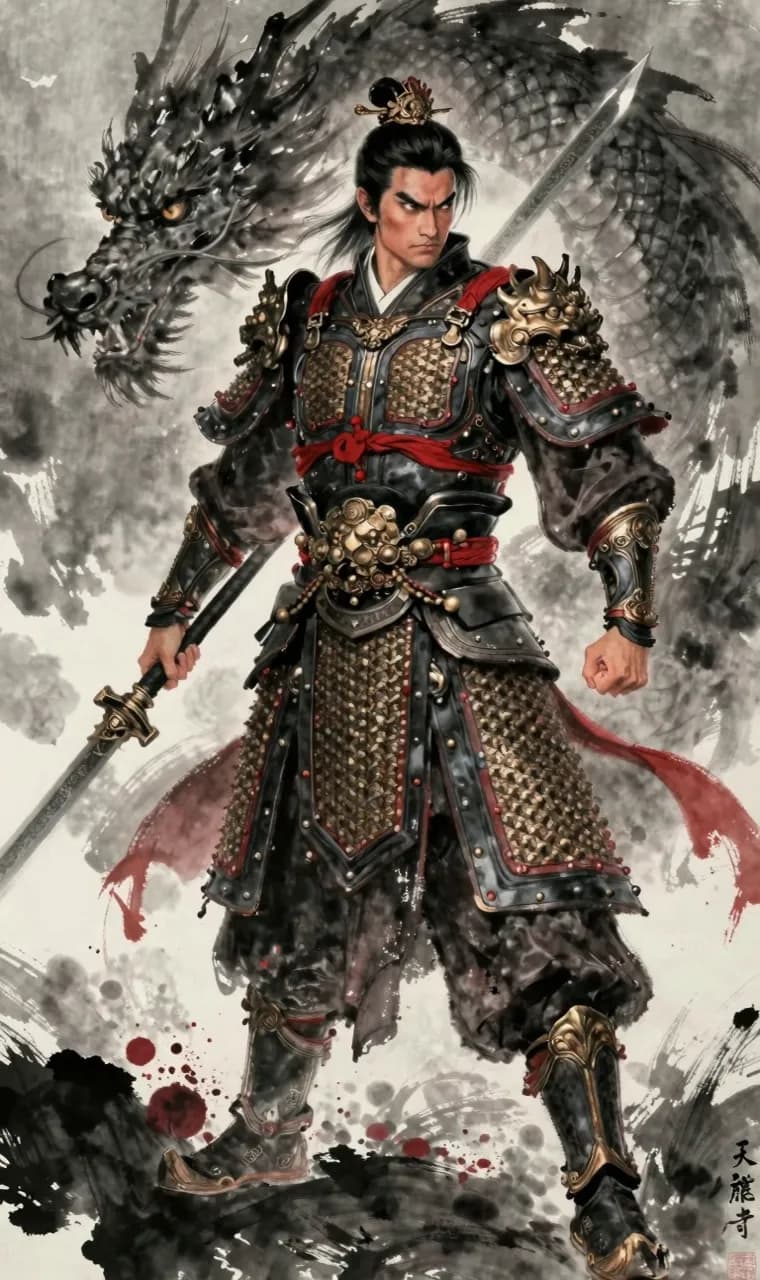
天龙 (Tiānlóng)
Tiānlóng
Dragão Celestial
Significado e Contexto Cultural
Do romance 'Demi-Gods and Semi-Devils' (Tian Long Ba Bu) de Jin Yong. Um guerreiro celestial com o poder dos dragões.
📖Contexto Cultural
天龙 (Tiānlóng) faz referência direta ao épico romance wuxia de Jin Yong 'Demi-Gods and Semi-Devils' (Tian Long Ba Bu), uma das obras mais amadas da literatura chinesa. O título em si vem da cosmologia budista e significa 'oito classes de seres celestiais'. Este nome evoca um mundo de artes marciais, cavalheirismo e temas filosóficos profundos. É ideal para um personagem com poderes místicos, um herói nobre ou um fã das obras de Jin Yong. O aspecto do dragão adiciona uma aura de autoridade celestial e mistério.
Quer um nome chinês personalizado? Experimente nosso gerador!
Gerar o MeuPontuação abrangente do nome
Each character has deep cultural significance with rich poetic and historical references
Two-character name has good tonal rhythm. Moderate tonal variation. Adjacent syllables have well-contrasted tones. Syllable lengths are balanced and easy to pronounce
Balanced stroke complexity with elegant structure
Single five-element attribute (water), pure but limited in variety
Two-character name feels modern and stylish
Referências de poesia clássica
Este nome carrega ecos da poesia clássica chinesa:
「天生我材必有用,千金散尽还复来」
Heaven has given me this talent for a purpose; a thousand pieces of gold scattered will return again
— Li Bai, 'Bring in the Wine'
Heaven endowed me with talent that must serve a purpose; though a fortune be spent, it will come back — confidence and boundless spirit.
「天行健,君子以自强不息」
As heaven's motion is vigorous and unceasing, the gentleman strives endlessly for self-improvement
— I Ching (Book of Changes)
Heaven moves with vigor and never ceases; the gentleman should emulate this by ceaselessly striving for self-improvement.
「长风破浪会有时,直挂云帆济沧海」
A time will come to ride the wind and cleave the waves; I'll hoist my cloud-like sail and cross the boundless sea
— Li Bai, 'Hard Roads in Shu'
Though the poem lacks the character '龙' (dragon), the imagery parallels a dragon soaring through clouds and seas
Someday I will ride the wind and break through the waves, hoisting my sail to cross the vast ocean — soaring ambition.
「龙游浅水遭虾戏,虎落平阳被犬欺」
A dragon wading in shallow water gets teased by shrimp; a tiger on the plains gets bullied by dogs
— Folk Proverb
Even a dragon can be tormented by shrimp in shallow waters — a metaphor for a hero in adversity, which only highlights the dragon's extraordinary nature.
「水不在深,有龙则灵」
The water need not be deep; with a dragon, it becomes enchanted
— Liu Yuxi, 'Inscription on a Humble Dwelling'
It matters not how deep the water is — a dragon gives it spirit. So too may a humble dwelling be fragrant when a person of virtue resides there.
Evolução do caractere
Explore como cada caractere evoluiu ao longo de mais de 3000 anos de história da escrita chinesa.
In oracle bone script,「天」depicts a standing human figure viewed from the front, with the head prominently emphasized — its original meaning is 'the top of the head.'
In bronze script,「天」began to extend from 'top of the head' to 'the sky,' with the head replaced by a horizontal stroke, forming the structure of「一」above「大」(great).
In seal script,「天」has「一」(one) above and「大」(great) below. The 'Shuowen' explains: 'Tian means the summit — the highest, with nothing above it.'
From the emphasized head of a human figure in oracle bone script, to the「一+大」composition after bronze script — 'the great One is Heaven' —「天」completed its elevation from a body part to the supreme cosmic entity.
In oracle bone script,「龙」(dragon) is a quintessential pictograph — a massive head, long body, and curled tail, resembling a sinuous mythical beast with horns and jaws.
In bronze script,「龙」became more elaborate and refined, with added crest ornaments and scale patterns that echo the dragon motifs on bronze vessels — a symbol of power and auspiciousness.
In seal script, the left side of「龙」shows the dragon's head and body, while the right side depicts its sweeping tail. Xu Shen's 'Shuowen' explains: 'The dragon is the chief of scaly creatures. It can be dark or bright, thin or enormous, short or long. At the spring equinox it ascends to heaven; at the autumn equinox it dives into the deep.'
From the simple pictograph of oracle bone script, to the ornate beauty of bronze script, to the stylized transformation of seal script,「龙」has always maintained the majestic posture of a divine beast. The dragon is the totem of the Chinese nation — using「龙」in a name expresses the hope that one's child will achieve greatness.
▶Estilos de caligrafia
In regular script,「龙」has many strokes but a rigorous structure — an excellent subject for practicing fundamental calligraphy skills.
In running script,「龙」simplifies some strokes — flowing like clouds and water without losing its commanding presence.
In cursive script,「龙」is swept out in a single stroke — like dragons soaring and phoenixes dancing — the ultimate expression of cursive script's wild beauty.
In clerical script,「龙」is broad and rectangular with distinct wave-like strokes — magnificent in Han dynasty stele inscriptions.
In seal script,「龙」preserves the most ancient and mysterious form — a classic subject in seal carving and calligraphic works.
Quando Usar Este Nome
Perguntas frequentes
O que significa o nome chinês 天龙 (Tiānlóng)?
天龙 (Tiānlóng) significa "Dragão Celestial" em chinês. Do romance 'Demi-Gods and Semi-Devils' (Tian Long Ba Bu) de Jin Yong. Um guerreiro celestial com o poder dos dragões.
Como se pronuncia 天龙 em chinês?
天龙 se pronuncia "Tiānlóng" em chinês mandarim. Pratique cuidadosamente o tom de cada sílaba para uma pronúncia precisa.
Quando devo usar o nome 天龙?
天龙 é um nome chinês versátil, adequado para nomes de usuário em jogos, perfis de redes sociais, aprendizado de idiomas e escrita criativa.
Compatibilidade zodiacal
Verifique quais signos zodiacais combinam bem com este nome com base nos radicais dos caracteres.