Why Is Trump Called "Chuānpǔ" in Chinese?: Discover why Donald Trump is called Chuānpǔ (川普) in Chinese. Learn the fascinating rules of Chinese transliteration, the mainland vs. Taiwan debate, and what foreign name translations reveal about Chinese culture.
Why Is Trump Called "Chuānpǔ" in Chinese?
"Chuānpǔ" Breaks Down as River + Universal
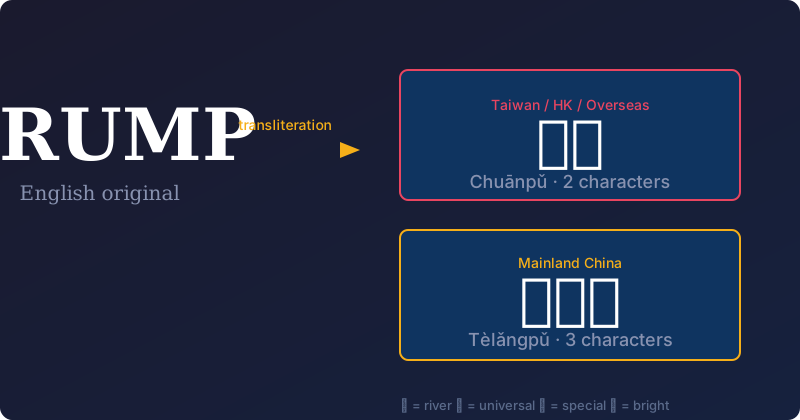
The Chinese name for Donald Trump is 川普 (Chuānpǔ). The first character 川 (chuān) means "river" or "stream," and the second character 普 (pǔ) means "universal" or "widespread." Neither character has anything to do with politics, business, or the Trump brand. They were chosen purely for how they sound — chuān approximates the "trum" syllable, and pǔ approximates the "p" sound at the end. This is the core principle of Chinese transliteration: selecting characters that mimic the original pronunciation while carrying neutral or positive meanings. The result is a two-character name that sounds reasonably close to "Trump" while reading as a legitimate Chinese name. However, "Chuānpǔ" is primarily used in Taiwan, Hong Kong, and overseas Chinese communities. Mainland China uses a different rendering entirely — and that difference tells a fascinating story about how Chinese handles foreign names.
The two Chinese renderings of "Trump" — a regional split driven by different transliteration systems
Mainland China Says "Tèlǎngpǔ" (特朗普), Not "Chuānpǔ"
Here is where it gets interesting. If you open a mainland Chinese newspaper or watch CCTV news, you will see Trump referred to as 特朗普 (Tèlǎngpǔ) — a three-character name that sounds quite different from the Taiwanese version. The breakdown: 特 (tè) means "special" or "extraordinary," 朗 (lǎng) means "bright" or "clear," and 普 (pǔ) is the same "universal" character used in the Taiwanese version. Why the split? It comes down to two different transliteration systems. Mainland China follows the Xinhua News Agency Reference for the Translation of Personal Names (新华社译名室), a government-managed guide that standardizes how every foreign name should be rendered. Under these rules, "Trump" is broken into three syllables: Te-lang-pu, because the "r" consonant cluster in "Trump" is not a natural fit for Mandarin phonology. Taiwan, by contrast, has no central authority for transliteration. Media outlets and translators historically adopted "Chuānpǔ" as a closer, punchier approximation. Both are widely understood, but the difference is instantly recognizable as a regional marker — like seeing "colour" versus "color" in English, except the words themselves are completely different.
The Rules Behind Chinese Transliteration
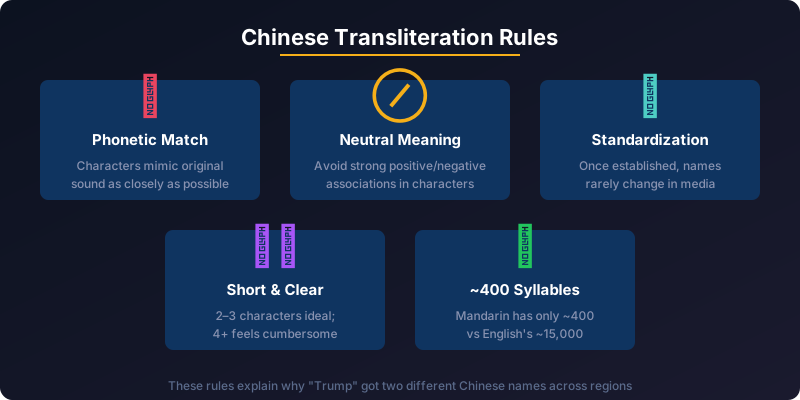
Chinese has about 400 syllables (compared to English's roughly 15,000), so mapping foreign sounds into Chinese is inherently imperfect. The process follows several guiding principles. First, phonetic approximation. The transliterator selects Chinese characters whose Mandarin pronunciation comes closest to the original sound. "Obama" becomes 奥巴马 (Àobāmǎ), where each character mirrors a syllable. Second, character neutrality. Characters used for transliteration should ideally be "empty vessels" — they should not carry strong positive or negative meanings that could bias perception. In practice, slight positive leanings are common (as in 特 "special" or 朗 "bright"). Third, standardization. Once a transliteration is established in major media, it becomes very hard to change. Consistency matters more than perfection. Fourth, number of characters. The transliteration should be as short as possible while remaining clear. Two or three characters is ideal. Four or more starts to feel cumbersome. These rules explain why "Trump" ended up with two different Chinese names: the mainland system prioritized syllable-by-syllable accuracy (Te-rum-pu → Tè-lǎng-pǔ), while the Taiwanese system prioritized brevity and overall sound similarity (Trum-p → Chuān-pǔ).
The five key principles that govern how foreign names become Chinese
What "Chuānpǔ" Teaches Us About Chinese Naming
The Trump transliteration debate illustrates something profound about Chinese names: every character carries meaning, even in transliterations where meaning is supposed to be secondary. When Chinese speakers read "川普" (river + universal), they unconsciously absorb those character associations. "River" suggests flow and continuity; "universal" suggests breadth and reach. Whether intentional or not, these subtle meanings color how the name is perceived. This is why Chinese transliteration is more than a mechanical process — it involves genuine linguistic and cultural judgment. The same principle applies when foreigners choose a Chinese name. Unlike transliteration (where sound is primary), a proper Chinese name prioritizes meaning, cultural resonance, and tonal harmony. The best Chinese names for foreigners go beyond phonetic mimicry — they tell a story through their characters. Someone named "Grace" might become "Ēn Huì" (恩惠, "grace + kindness"), which sounds different but captures the essence. This is exactly the gap that AI-powered Chinese name generators can bridge: they understand both the phonetic and meaning dimensions, producing names that work on every level.
Other Famous Name Splits: Mainland vs. Taiwan
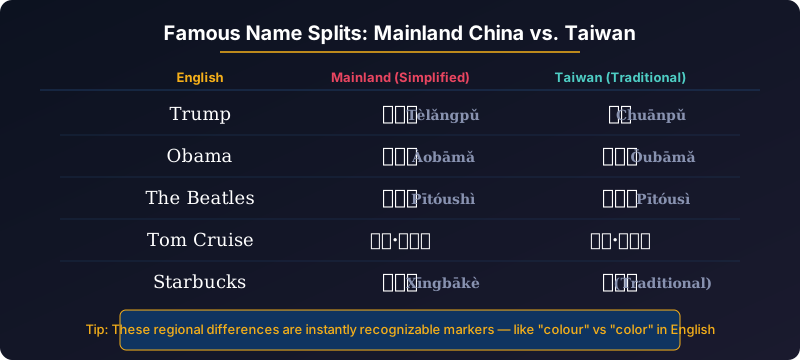
Trump is not the only foreign name with different Chinese renderings. Obama is 奥巴马 (Àobāmǎ) in the mainland but 歐巴馬 (Ōubāmǎ) in Taiwan — same pronunciation, different characters (traditional vs. simplified). The Beatles are 披头士 (Pītóushì, "draped hair scholars") in the mainland but 披頭四 (Pītóusì, "draped hair four") in Taiwan — a subtle but real difference in meaning. Even Harry Potter has a slight variation: 哈利·波特 (Hālì Bōtè) in the mainland versus 哈利波特 (same characters, no middle dot) in Taiwan. These differences accumulate into a recognizable regional pattern that any Chinese speaker can identify within seconds.
Well-known names rendered differently across Chinese-speaking regions
How to Choose Your Own Chinese Name (the Right Way)
If the Trump example has you thinking about getting your own Chinese name, here are the key lessons. Do not just transliterate your English name. "Chuānpǔ" works for Trump because he did not choose it — it was assigned by media convention. When you choose your own name, you have the freedom to go deeper. Pick characters with meanings you genuinely like. Unlike transliteration characters (which are intentionally bland), your chosen name characters should reflect your personality or aspirations. Consider tonal harmony. Say the full name aloud. A name with complementary tones (e.g., rising + falling) sounds more musical than one where both characters share the same tone. Get a native speaker's opinion. They will catch homophone risks and cultural red flags that you might miss. Use AI as a starting point, not the final word. Our Chinese name generator produces culturally appropriate suggestions with full character breakdowns, but a human review adds the cultural intuition that makes a name truly yours.
Perguntas frequentes
Why is Trump called differently in mainland China and Taiwan?
The split comes from two different transliteration systems. Mainland China uses the Xinhua News Agency's official transliteration guide, which renders 'Trump' as 特朗普 (Tèlǎngpǔ, three syllables). Taiwan's media adopted 川普 (Chuānpǔ, two syllables), a shorter approximation. Both are widely understood across the Chinese-speaking world.
Do the characters in "Chuānpǔ" mean anything related to Trump?
No. 川 (chuān) means 'river' and 普 (pǔ) means 'universal.' They were chosen for how they sound, not what they mean. This is standard practice in Chinese transliteration of foreign names — character meaning is secondary to phonetic approximation.
Which is the "correct" Chinese name for Trump?
Neither is more correct. 特朗普 (Tèlǎngpǔ) is standard in mainland China, while 川普 (Chuānpǔ) is standard in Taiwan, Hong Kong, and many overseas Chinese communities. If you are writing for a mainland audience, use 特朗普. For Taiwan or general international Chinese audiences, 川普 is common.
Can I choose my own Chinese transliteration like foreign politicians do?
Foreign politicians and celebrities typically do not choose their Chinese transliterations — they are assigned by media organizations and stick through convention. When choosing your own Chinese name, you have more freedom: you can go beyond transliteration and pick characters with meanings you like, creating a name that is truly personal.
Pronto para encontrar seu nome chinês?
Experimente nosso gerador de nomes chineses com IA — gratuito, com pinyin, significados e contexto cultural.