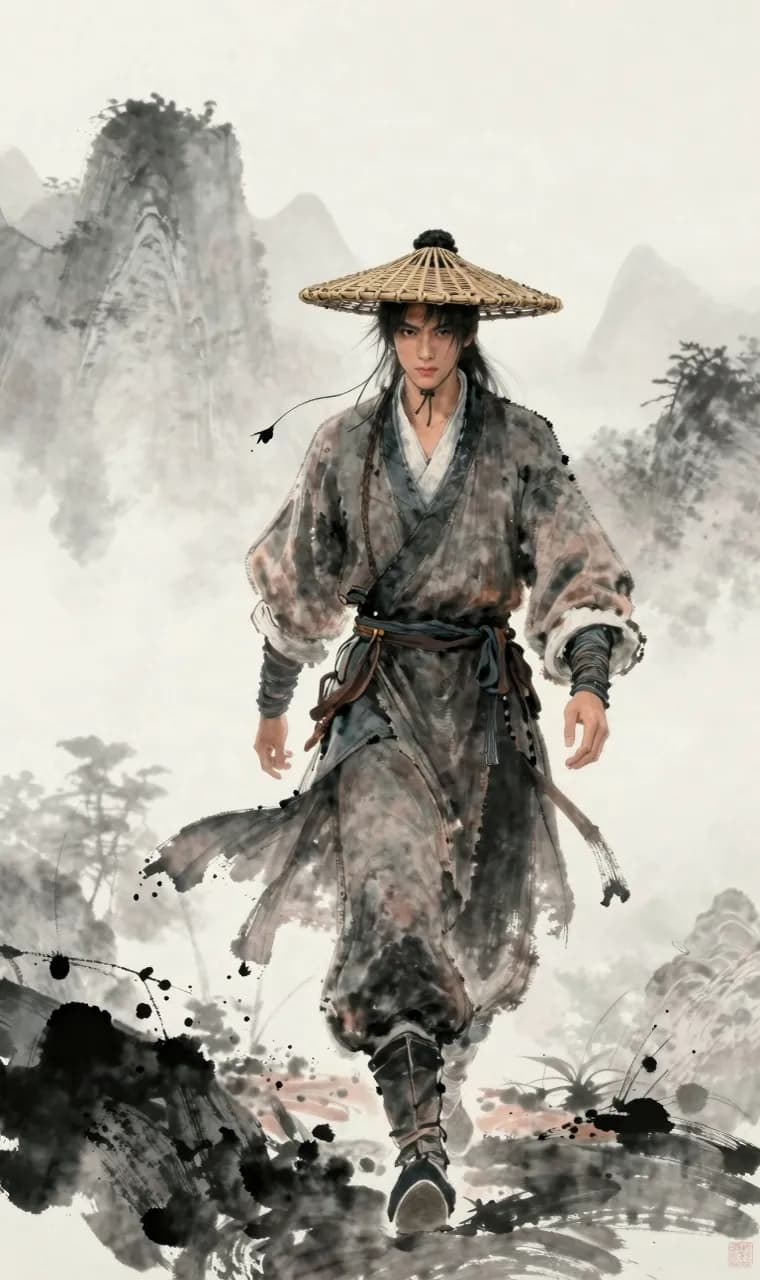
云飞扬 (Yún Fēiyáng)
Yún Fēiyáng
Nuages Volants
Signification & Contexte Culturel
Libre et sans contrainte, comme des nuages planant dans le ciel infini.
📖Contexte culturel
Ce nom capture l'image de nuages flottant librement dans le ciel, symbolisant un esprit insouciant et sans contrainte. Il rappelle l'idéal taoïste de l'errance sans attache. Ce nom convient à un personnage libre d'esprit dans les jeux ou les histoires, évoquant un sentiment de liberté infinie et d'élégance naturelle. 'Feiyang' suggère également de hautes ambitions.
Vous voulez un nom chinois personnalisé ? Essayez notre générateur !
Générer le MienScore global du nom
Each character has deep cultural significance with rich poetic and historical references
Multi-character name has rich tonal layering. Moderate tonal variation. Adjacent syllables have well-contrasted tones. Syllable lengths are balanced and easy to pronounce
Moderate stroke count
Single five-element attribute (water), pure but limited in variety
Three-character name has a traditional, grounded feel
Références poétiques classiques
Ce nom porte les échos de la poésie classique chinoise :
「行到水穷处,坐看云起时」
Walking to where the stream runs dry, I sit and watch the clouds rise
— Wang Wei, 'My Retreat at Mount Zhongnan'
When the path ends where the stream dries up, I sit and watch the clouds gather — a serene acceptance of life's natural course.
「曾经沧海难为水,除却巫山不是云」
Having seen the vast ocean, no other water can compare; having beheld the clouds of Mount Wu, no other clouds are worthy
— Yuan Zhen, 'Thoughts of Parting'
Having witnessed the boundless ocean, no other water suffices; having seen the clouds above Mount Wu, no others are worthy — a love so deep it eclipses all else.
「浮云游子意,落日故人情」
Floating clouds mirror the wanderer's thoughts; the setting sun reflects an old friend's feelings
— Li Bai, 'Farewell to a Friend'
Drifting clouds resemble the wanderer's restless path; the setting sun mirrors an old friend's lingering sorrow — a classic farewell poem.
「飞流直下三千尺,疑是银河落九天」
The waterfall plunges three thousand feet; it seems the Milky Way has tumbled from the ninth heaven
— Li Bai, 'Viewing the Lushan Waterfall'
The waterfall cascades three thousand feet down — one might think the Milky Way has poured from the highest heavens — a scene of overwhelming grandeur.
「两个黄鹂鸣翠柳,一行白鹭上青天」
Two golden orioles sing among the emerald willows; a row of white egrets soars into the blue sky
— Du Fu, 'Quatrain'
Two golden orioles sing in the green willows, a line of white egrets rises into the blue sky — a vividly colored painting in poetry.
Évolution des caractères
Explorez l'évolution de chaque caractère à travers plus de 3000 ans d'histoire de l'écriture chinoise.
In oracle bone script,「云」resembles rolling clouds in the sky — a pure pictograph. The upper part is the cloud layer, the lower part is the trailing cloud wisps.
In bronze script,「云」gained a「雨」(rain) header, becoming「雲」— emphasizing the relationship between clouds and rain.
In seal script,「云」has two forms:「云」(the cloud-vapor pictograph) and「雲」(with the rain header added). The 'Shuowen' explains: 'Yun is the breath of mountains and rivers.'
From the simplest cloud pictograph, to the complex form「雲」with the rain header, and back to the simplified form that returns to the ancient original — a full circle. Clouds symbolize loftiness, freedom, and effortless grace.
In oracle bone script,「飞」resembles a bird with wings spread wide in flight — a quintessential pictograph.
In bronze script, the image of「飞」became more vivid, with the bird's spread-wing posture clearly visible.
In seal script,「飞」resembles a bird with both wings outspread. The 'Shuowen' explains: 'Fei means a bird taking flight.'
From the flying bird image of oracle bone script to the streamlined form of simplified Chinese — though the strokes were greatly reduced, the imagery of flight remains unchanged. Using「飞」in a name signifies soaring ambition and limitless horizons.
Quand Utiliser Ce Nom
Questions fréquentes
Que signifie le nom chinois 云飞扬 (Yún Fēiyáng) ?
云飞扬 (Yún Fēiyáng) signifie « Nuages Volants » en chinois. Libre et sans contrainte, comme des nuages planant dans le ciel infini.
Comment prononcer 云飞扬 en chinois ?
云飞扬 se prononce « Yún Fēiyáng » en chinois mandarin. Pratiquez attentivement le ton de chaque syllabe pour une prononciation précise.
Quand utiliser le nom 云飞扬 ?
云飞扬 est un nom chinois polyvalent, adapté aux pseudonymes de jeu, aux profils de réseaux sociaux, à l'apprentissage des langues et à l'écriture créative.
Compatibilité zodiacale
Vérifiez quels signes zodiacaux s'accordent bien avec ce nom selon les radicaux des caractères.