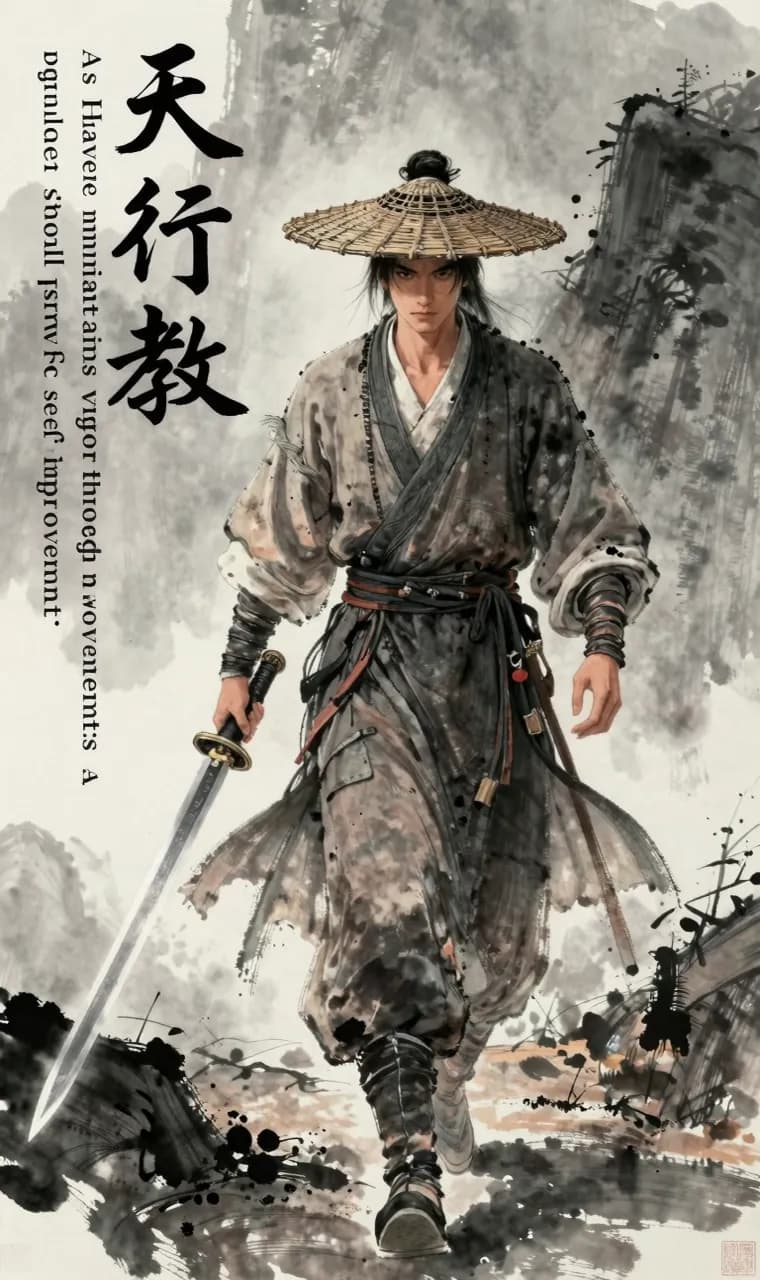
天行 (Tiānxíng)
Tiānxíng
Marcher dans les Cieux
Signification & Contexte Culturel
Du Yi Jing : 'De même que le Ciel maintient sa vigueur par le mouvement, l'homme noble doit constamment s'efforcer de s'améliorer.'
📖Contexte culturel
天行 (Tiānxíng) est directement tiré du Yi Jing : '天行健,君子以自强不息' (De même que le mouvement du Ciel est toujours vigoureux, l'homme noble s'efforce constamment de s'améliorer). Cette phrase a inspiré d'innombrables érudits et guerriers dans l'histoire chinoise, incarnant un effort incessant et une intégrité morale. Le nom suggère une personne de hautes ambitions et d'esprit inflexible, comme un marcheur du ciel. C'est un choix puissant pour un héros dans un roman wuxia, un nom d'utilisateur motivant ou une marque de fitness ou d'éducation. 'Ciel' représente l'autorité ultime et la nature, tandis que 'marcher' implique une poursuite active.
Vous voulez un nom chinois personnalisé ? Essayez notre générateur !
Générer le MienScore global du nom
Each character has deep cultural significance with rich poetic and historical references
Two-character name has good tonal rhythm. Moderate tonal variation. Adjacent syllables have well-contrasted tones. Syllable lengths are balanced and easy to pronounce
Moderate stroke count
No five-element data available.
Two-character name feels modern and stylish. Low total stroke count is minimalist and easy to write
Références poétiques classiques
Ce nom porte les échos de la poésie classique chinoise :
「天生我材必有用,千金散尽还复来」
Heaven has given me this talent for a purpose; a thousand pieces of gold scattered will return again
— Li Bai, 'Bring in the Wine'
Heaven endowed me with talent that must serve a purpose; though a fortune be spent, it will come back — confidence and boundless spirit.
「天行健,君子以自强不息」
As heaven's motion is vigorous and unceasing, the gentleman strives endlessly for self-improvement
— I Ching (Book of Changes)
Heaven moves with vigor and never ceases; the gentleman should emulate this by ceaselessly striving for self-improvement.
Évolution des caractères
Explorez l'évolution de chaque caractère à travers plus de 3000 ans d'histoire de l'écriture chinoise.
In oracle bone script,「天」depicts a standing human figure viewed from the front, with the head prominently emphasized — its original meaning is 'the top of the head.'
In bronze script,「天」began to extend from 'top of the head' to 'the sky,' with the head replaced by a horizontal stroke, forming the structure of「一」above「大」(great).
In seal script,「天」has「一」(one) above and「大」(great) below. The 'Shuowen' explains: 'Tian means the summit — the highest, with nothing above it.'
From the emphasized head of a human figure in oracle bone script, to the「一+大」composition after bronze script — 'the great One is Heaven' —「天」completed its elevation from a body part to the supreme cosmic entity.
Quand Utiliser Ce Nom
Questions fréquentes
Que signifie le nom chinois 天行 (Tiānxíng) ?
天行 (Tiānxíng) signifie « Marcher dans les Cieux » en chinois. Du Yi Jing : 'De même que le Ciel maintient sa vigueur par le mouvement, l'homme noble doit constamment s'efforcer de s'améliorer.'
Comment prononcer 天行 en chinois ?
天行 se prononce « Tiānxíng » en chinois mandarin. Pratiquez attentivement le ton de chaque syllabe pour une prononciation précise.
Quand utiliser le nom 天行 ?
天行 est un nom chinois polyvalent, adapté aux pseudonymes de jeu, aux profils de réseaux sociaux, à l'apprentissage des langues et à l'écriture créative.
Compatibilité zodiacale
Vérifiez quels signes zodiacaux s'accordent bien avec ce nom selon les radicaux des caractères.