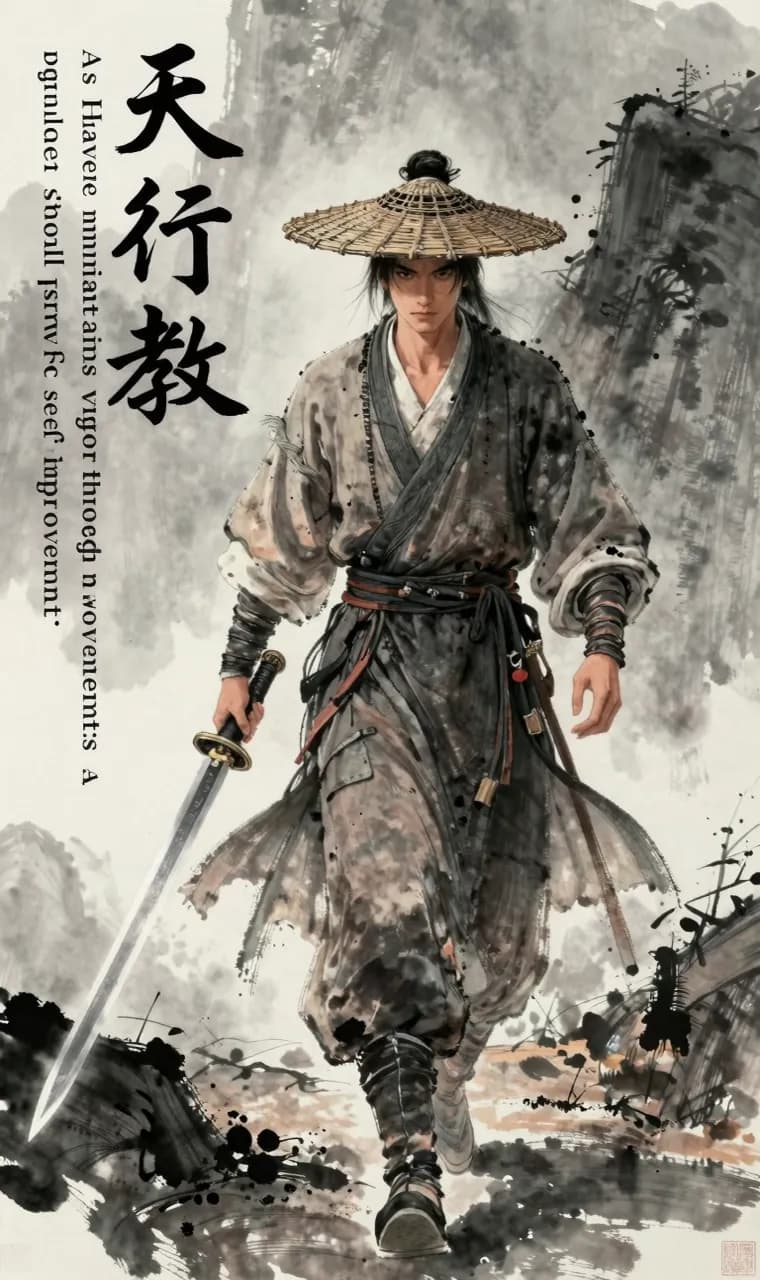
天行 (Tiānxíng)
Tiānxíng
Caminando los Cielos
Significado y Contexto Cultural
Del I Ching: 'Así como el cielo mantiene su vigor mediante el movimiento, el hombre noble debe esforzarse constantemente por superarse.'
📖Antecedentes culturales
天行 (Tiānxíng) está tomado directamente del I Ching: '天行健,君子以自强不息' (Así como el movimiento del cielo es siempre vigoroso, la persona noble se esfuerza constantemente por superarse). Esta frase ha inspirado a innumerables eruditos y guerreros en la historia china, encarnando el esfuerzo incansable y la integridad moral. El nombre sugiere una persona de altas ambiciones y espíritu inquebrantable, como un caminante del cielo. Es una elección poderosa para un héroe en una novela wuxia, un nombre de usuario motivador o una marca de fitness o educación. 'Cielo' representa la autoridad suprema y la naturaleza, mientras que 'caminar' implica búsqueda activa.
¿Quieres un nombre chino personalizado? ¡Prueba nuestro generador!
Generar el MíoPuntuación integral del nombre
Each character has deep cultural significance with rich poetic and historical references
Two-character name has good tonal rhythm. Moderate tonal variation. Adjacent syllables have well-contrasted tones. Syllable lengths are balanced and easy to pronounce
Moderate stroke count
No five-element data available.
Two-character name feels modern and stylish. Low total stroke count is minimalist and easy to write
Referencias de poesía clásica
Este nombre lleva ecos de la poesía clásica china:
「天生我材必有用,千金散尽还复来」
Heaven has given me this talent for a purpose; a thousand pieces of gold scattered will return again
— Li Bai, 'Bring in the Wine'
Heaven endowed me with talent that must serve a purpose; though a fortune be spent, it will come back — confidence and boundless spirit.
「天行健,君子以自强不息」
As heaven's motion is vigorous and unceasing, the gentleman strives endlessly for self-improvement
— I Ching (Book of Changes)
Heaven moves with vigor and never ceases; the gentleman should emulate this by ceaselessly striving for self-improvement.
Evolución del carácter
Explore cómo cada carácter evolucionó a lo largo de más de 3000 años de historia de la escritura china.
In oracle bone script,「天」depicts a standing human figure viewed from the front, with the head prominently emphasized — its original meaning is 'the top of the head.'
In bronze script,「天」began to extend from 'top of the head' to 'the sky,' with the head replaced by a horizontal stroke, forming the structure of「一」above「大」(great).
In seal script,「天」has「一」(one) above and「大」(great) below. The 'Shuowen' explains: 'Tian means the summit — the highest, with nothing above it.'
From the emphasized head of a human figure in oracle bone script, to the「一+大」composition after bronze script — 'the great One is Heaven' —「天」completed its elevation from a body part to the supreme cosmic entity.
Cuándo Usar Este Nombre
Preguntas frecuentes
¿Qué significa el nombre chino 天行 (Tiānxíng)?
天行 (Tiānxíng) significa "Caminando los Cielos" en chino. Del I Ching: 'Así como el cielo mantiene su vigor mediante el movimiento, el hombre noble debe esforzarse constantemente por superarse.'
¿Cómo se pronuncia 天行 en chino?
天行 se pronuncia "Tiānxíng" en chino mandarín. Practique cuidadosamente el tono de cada sílaba para una pronunciación precisa.
¿Cuándo debo usar el nombre 天行?
天行 es un nombre chino versátil adecuado para nombres de usuario en juegos, perfiles de redes sociales, aprendizaje de idiomas y escritura creativa.
Compatibilidad zodiacal
Verifique qué signos zodiacales combinan bien con este nombre según los radicales de los caracteres.